Business & Strategy
SaaS Development Company: What Actually Determines Long-Term Success

Skyen Systems Team · Jul 8, 2026 · 5 min read
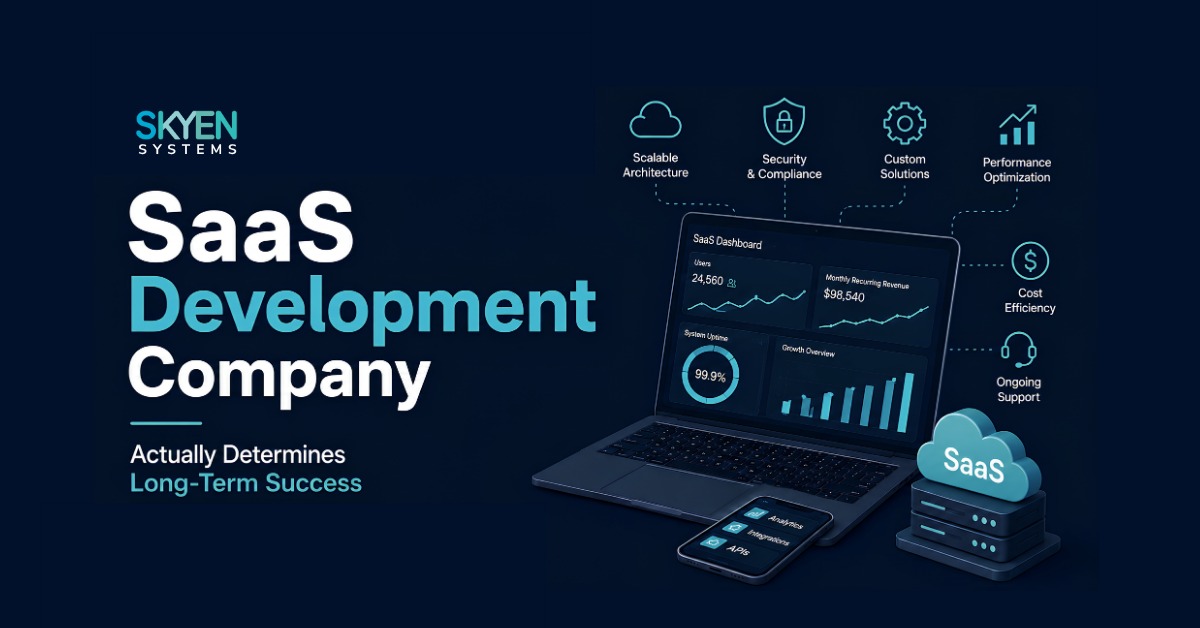
Skyen Systems builds scalable SaaS products with multi-tenant architecture, subscription billing, cloud infrastructure, security, and long-term maintainability.
A SaaS development company builds scalable, subscription-based software designed to serve many customers from a single codebase, with architecture that supports continuous updates and growth. Choosing the right partner matters because SaaS products live or die on scalability, security, and maintainability decisions made early.
Building a SaaS product is a fundamentally different challenge from building a one-off business application. A SaaS development company needs to design for multi-tenancy, continuous deployment, and unpredictable scaling from day one, not retrofit these capabilities after launch. At Skyen Systems, we've built SaaS products across multiple industries, and the pattern is consistent: the platforms that scale smoothly are the ones where architecture decisions were made deliberately, not by accident.
This guide covers what genuinely matters when building a SaaS product, the technical foundations that determine long-term success, and what to look for in a development partner.
What Makes SaaS Development Different
Unlike custom software built for a single business, SaaS products need architecture that supports many customers simultaneously, often with different configurations, data volumes, and usage patterns. This multi-tenant requirement shapes nearly every technical decision from the database layer up.
SaaS development services also require thinking about the product as an ongoing, evolving system rather than a one-time delivery. Continuous integration and deployment pipelines aren't optional extras — they're core to how a SaaS business operates and ships improvements without disrupting existing customers.
Subscription billing, usage metering, and tiered feature access add further complexity that doesn't exist in typical business software, and these need to be built into the core architecture rather than bolted on as an afterthought.
Building a Scalable SaaS App From the Ground Up
A scalable SaaS app starts with a database architecture that can handle growth without requiring a full rebuild. Many successful SaaS companies use a hybrid approach, combining relational databases like PostgreSQL for structured data with caching layers like Redis for performance under load.
Cloud infrastructure choices matter enormously here. Most modern SaaS development Australia projects deploy on AWS, Azure, or Google Cloud, using containerisation through Docker and orchestration through Kubernetes to handle scaling automatically as customer demand grows.
API design also deserves early attention. A well-structured API layer allows a SaaS product to support integrations, mobile apps, and third-party partnerships later without requiring a fundamental rework of the core system.
Why Australian SaaS Companies Face Unique Considerations
Australian SaaS businesses often need to serve both domestic and international customers, which raises data residency questions that don't affect companies operating purely within one jurisdiction. Some customers require Australian data hosting specifically, particularly in regulated industries like finance and health.
Time zone considerations also matter more than founders initially expect. A SaaS platform serving customers across Australia, Asia, and beyond needs infrastructure and support processes designed around genuinely different working hours, not just a single business day.
Competition in the local SaaS Development Australia space has intensified, which means differentiation increasingly comes down to execution quality and reliability, not just having a good idea.
Common Mistakes in Early-Stage SaaS Development
The most damaging mistake is under-investing in the core architecture to hit an early deadline, then discovering that scaling requires a costly rebuild once customer numbers grow. This happens far more often than founders expect, and it's almost always avoidable with proper planning.
Security also gets deprioritised too often in early builds. SaaS products handling customer data across multiple tenants need robust access controls and data isolation from the very first version, not as a retrofit once a serious customer asks about it.
Ignoring observability — logging, monitoring, and error tracking — until something breaks in production is another common pattern. Building this in early makes debugging and scaling dramatically easier down the line.
Choosing the Right SaaS Development Partner
Look for a development partner who asks detailed questions about your growth projections and customer segmentation before proposing an architecture. A team that jumps straight into building without this context risks designing for the wrong scale entirely.
Experience with subscription billing systems, usage-based pricing, and multi-tenant security models matters specifically for SaaS projects — general software development experience alone doesn't cover these SaaS-specific complexities.
At Skyen Systems, we've delivered SaaS products for Australian businesses across industries, and our approach always starts with understanding growth trajectory and customer base before any architecture decisions get made.
Final Thoughts
Building a successful SaaS product requires architecture decisions that support growth from day one, not retrofitted scalability after a painful bottleneck. The businesses that get this right treat their SaaS development company as a genuine technical partner, not just a vendor executing a feature list.
Ready to build a SaaS product designed to scale from day one? Contact Skyen Systems today for a free technical consultation, and let's map out the right architecture for your growth plans.
Frequently Asked Questions
How much does it cost to work with a SaaS development company in Australia?
Costs vary by complexity, but most SaaS development services in Australia range from $40,000 to $250,000+ for an initial scalable build, depending on features and multi-tenant requirements.
What makes a SaaS app genuinely scalable?
A scalable SaaS app relies on multi-tenant architecture, cloud infrastructure that scales automatically, and a database design that handles growth without requiring a full rebuild.
Do Australian SaaS companies need local data hosting?
Not always, but many regulated industries and enterprise customers require Australian data residency, making it an important consideration during SaaS Development Australia projects.
How long does it take to build an MVP-stage SaaS product?
A well-scoped SaaS MVP typically takes four to seven months, though this varies significantly based on integration complexity and required compliance features.
What's the biggest risk in early-stage SaaS development?
Under-investing in core architecture to hit an early deadline is the most common and costly mistake, often forcing an expensive rebuild once the customer base grows.