UI/UX Design
MVP Development Australia: How Startups Build and Launch Faster

Skyen Systems Team · Jul 3, 2026 · 6 min read
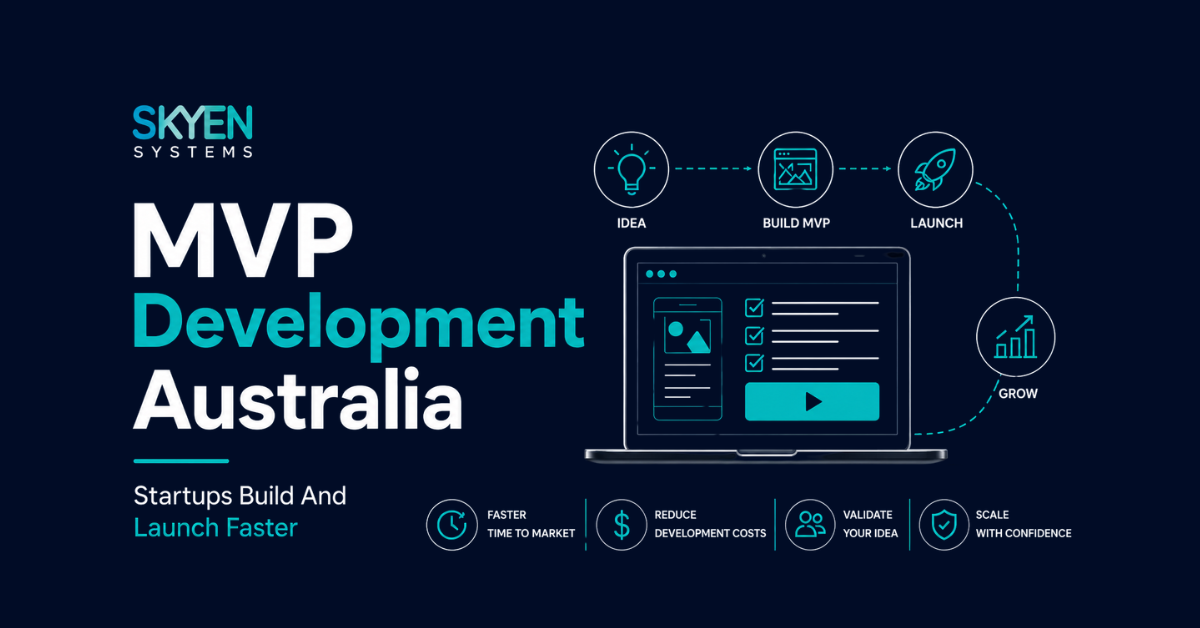
Skyen Systems helps Australian startups build and launch MVPs with focused features, scalable architecture, analytics, and fast validation.
MVP development in Australia means building the smallest working version of a product that still solves a real customer problem, so founders can test demand before investing in full-scale software. It's the fastest, lowest-risk way to validate a startup idea with real users.
Australian startups face a familiar challenge: limited runway and pressure to prove traction fast. MVP development Australia projects exist precisely to solve this problem, giving founders a functional product to test with real users without burning through months of budget on features nobody has asked for. At Skyen Systems, we've guided founders across fintech, healthtech, and marketplace startups through this exact process, and the pattern is consistent — the startups that move fastest are the ones that resist building everything at once.
This guide walks through what MVP development actually involves, why it matters specifically for the Australian startup ecosystem, and how to plan a build that gets you to real user feedback quickly.
What Is an MVP, Really?
A minimum viable product is not a stripped-down, buggy version of your full vision. It's a deliberately scoped product built around a single core value proposition, designed to test one critical assumption about what customers actually want.
Startup MVP development succeeds or fails based on scoping discipline. The goal isn't to build less software — it's to build the right, smallest slice of software that answers a specific question: will people use this, and will they pay for it?
Founders who confuse an MVP with a cheap version of the final product usually end up rebuilding from scratch once real user feedback comes in. A well-scoped MVP anticipates this and treats early feedback as the entire point of the exercise.
Why MVP Development Matters More in Australia's Startup Environment
Australia's startup funding landscape is smaller and more conservative than markets like the US or UK. Investors here typically want to see validated demand before committing serious capital, which makes MVP app development a near-mandatory step rather than an optional one.
This also shapes how Australian founders should think about timelines. With less access to large seed rounds, most local startups need to reach a working MVP within three to five months, not the six-to-twelve-month timelines that better-funded overseas startups can sometimes afford.
There's a practical upside to this constraint. Australian founders who build MVPs efficiently often end up with leaner, more focused products — because every feature had to justify its place in a tight budget and timeline.
How to Build an MVP Australia Founders Can Actually Launch On Time
The process starts with ruthless prioritisation. List every feature the full product vision includes, then identify the single core workflow that delivers the product's main value. Everything else gets deferred to post-launch iterations.
Technical architecture should favour speed without sacrificing scalability entirely. Many Australian MVP builds use frameworks like React or Next.js on the front end, paired with Node.js or Django on the back end, hosted on scalable cloud infrastructure like AWS or Google Cloud from day one.
It's worth resisting the temptation to over-engineer the MVP for future scale. A product built for one thousand users doesn't need infrastructure designed for one million — that complexity can be added later, once the business has actual traction data to justify it.
Common Mistakes in MVP App Development
The most common mistake is scope creep during development. Founders add "just one more feature" repeatedly, and a four-month MVP timeline quietly becomes nine months, by which point the market opportunity may have shifted.
Another frequent error is skipping analytics from launch. Without proper tracking built into the MVP from day one, founders can't measure whether users are actually engaging with the core feature — which defeats the entire purpose of building an MVP in the first place.
Founders also sometimes build for imagined edge cases instead of real ones. It's far more valuable to launch with a narrow but functional feature set and let actual user behaviour reveal which edge cases matter, rather than guessing upfront.
From MVP to Full Product: Planning the Next Phase
A successful MVP generates two things: user feedback and usage data. Both should directly inform the next development phase, rather than reverting to the original, pre-launch product roadmap.
Technical debt is normal at this stage, and that's fine. MVPs are built for speed, not permanence, so it's expected that parts of the codebase will need refactoring once the product's direction is validated and investment increases.
Founders should also revisit their technology stack once real usage patterns are clear. A database or hosting setup that worked for 500 early users may need to change entirely once a product scales to 50,000 — and that's a healthy sign of growth, not a mistake made earlier.
Choosing a Development Partner to Build MVP Australia Startups Can Trust
Startups need a development partner who understands the specific constraints of MVP work — tight timelines, limited budgets, and the need to prioritise ruthlessly. This is a different skill set from building large-scale enterprise software.
Look for a team that asks hard questions about your core assumption before writing any code, rather than one that simply takes a feature list and starts building. The best MVP partners push back on scope, because they know an unfocused MVP wastes both time and money.
At Skyen Systems, we've built MVPs for Australian founders across multiple industries, always starting with the same question: what's the one thing this product needs to prove? That focus is what lets us deliver working products in months, not years.
Final Thoughts
MVP development gives Australian startups a fast, low-risk way to test real demand before committing to a full product build. The founders who succeed treat their MVP as a learning tool first and a product second, using early feedback to shape what comes next.
Ready to turn your startup idea into a working product? Contact Skyen Systems today for a free MVP scoping session, and let's define exactly what your first build needs to prove.
Frequently Asked Questions
How much does MVP development cost in Australia?
Most MVP development Australia projects range from $15,000 to $60,000, depending on complexity, platform, and the number of core features included in the initial build.
How long does it take to build MVP Australia founders can launch?
A well-scoped MVP typically takes three to five months, though simpler single-feature products can launch in as little as eight to ten weeks.
What's the difference between an MVP and a prototype?
A prototype demonstrates an idea visually or functionally without real back-end infrastructure, while an MVP is a fully working product that real users can sign up for and use.
Do I need funding before starting MVP app development?
Not necessarily. Many founders self-fund their MVP to generate traction data, which then strengthens their position when raising a seed round from investors.
Can an MVP scale into a full product later?
Yes, if the architecture is chosen thoughtfully from the start. A well-built MVP can evolve into the full product, though some refactoring is normal as user numbers grow.