AI & Automation
AI Software Development: A Technical Guide for Australian Businesses

Skyen Systems Team · Jul 6, 2026 · 7 min read
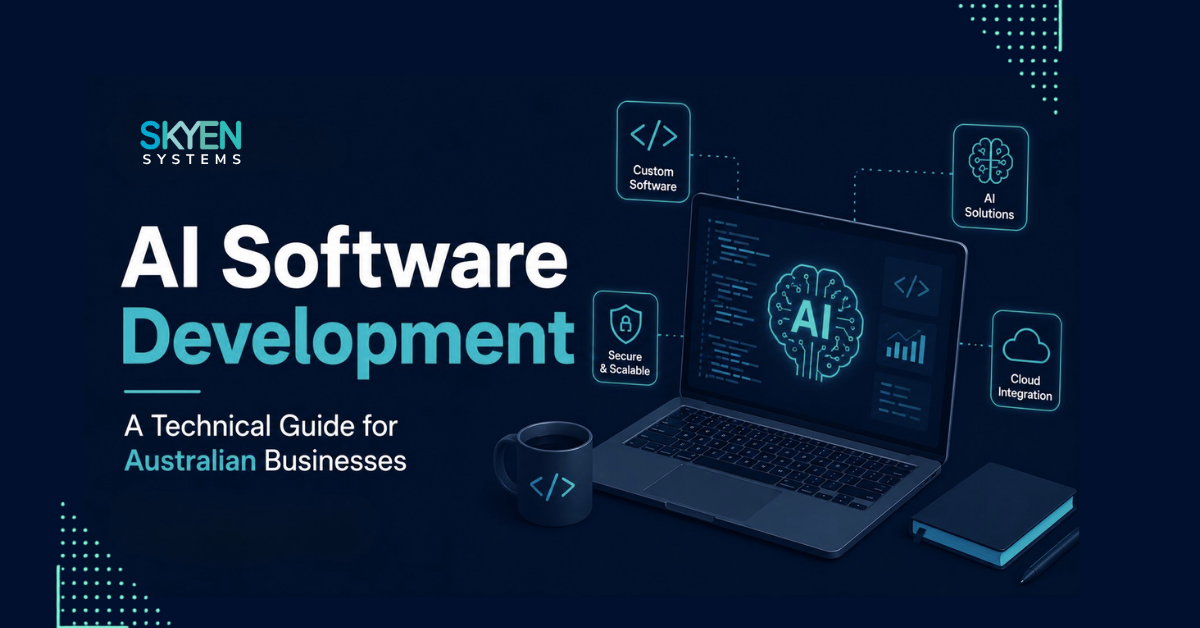
Skyen Systems builds AI-powered software for Australian businesses using machine learning, natural language processing, computer vision, and secure data systems.
AI software development is the process of building applications that use machine learning, natural language processing, or computer vision to automate tasks, generate insights, or make predictions. Australian businesses adopt it to reduce manual work and unlock decisions that traditional software can't make on its own.
Every industry in Australia is now asking the same question: where does AI actually fit into our business? AI software development answers that question by turning abstract machine learning capability into working, deployable systems built around a specific business problem. At Skyen Systems, we've delivered AI-powered software for clients in logistics, finance, and healthcare, and the common thread is always the same — the most successful projects start with a clear problem, not a fascination with the technology itself.
This guide covers what AI software development actually involves, how Australian businesses are using it in practice, and what to consider before starting a project.
What AI Software Development Actually Involves
AI software development combines traditional software engineering with machine learning models, natural language processing, or computer vision components. Unlike conventional software, which follows explicit rules written by developers, AI systems learn patterns from data and apply them to new situations.
This distinction matters practically. Building AI-powered software requires not just developers, but also data scientists who can select, train, and validate models suited to the specific problem. Poor model selection or insufficient training data leads to unreliable outputs, regardless of how well the surrounding software is built.
An AI software company in Australia typically works across three layers: the underlying model or API, the application logic that uses its outputs, and the user interface that makes those outputs useful to real people.
Where Australian Businesses Are Applying AI Right Now
Customer service is one of the most common entry points. Australian businesses are deploying AI-powered chatbots and support tools that handle routine queries, freeing human staff to focus on complex cases that actually need judgment.
Document processing is another high-value use case, particularly in finance and legal services. AI development services can automate the extraction and classification of information from contracts, invoices, and forms — work that previously required hours of manual review.
Predictive analytics is growing fast in logistics and retail, where AI models forecast demand, optimise inventory, or flag supply chain risks before they become costly problems. These aren't experimental use cases anymore — they're delivering measurable ROI for Australian companies today.
Choosing the Right AI Approach for Your Business Problem
Not every business problem needs a custom-trained model. Many use cases can be solved effectively using pre-trained models accessed through APIs, such as OpenAI's or Anthropic's language models, which dramatically reduces development time and cost.
Custom model training becomes necessary when a business has highly specific data patterns that generic models don't handle well — think fraud detection tuned to a particular industry's transaction patterns, or image recognition trained on proprietary product catalogues.
The right approach depends on data availability as much as the problem itself. Businesses with large, clean historical datasets are well positioned for custom models, while those without this foundation often get more value from integrating existing AI-powered software and APIs first.
The Technical Stack Behind AI-Powered Software
Most modern AI software development projects rely on Python as the primary language for model development, using frameworks like TensorFlow or PyTorch for custom machine learning work. For applications built around large language models, integration typically happens through REST APIs connected to a standard web application back end.
Data infrastructure matters just as much as the model itself. Vector databases like Pinecone or Weaviate have become standard for applications using retrieval-augmented generation, allowing AI systems to reference specific business data accurately rather than relying purely on general training knowledge.
Cloud infrastructure choices also shape performance and cost. AWS, Google Cloud, and Azure all offer managed AI services, and the right choice often depends on which platform a business already uses for its existing infrastructure.
Common Pitfalls in AI Development Projects
The most frequent mistake is treating AI as a solution before defining the actual problem. Businesses that start with "we need an AI feature" rather than "we need to solve this specific inefficiency" often end up with impressive demos that never get proper adoption.
Data quality issues derail more projects than model selection does. AI systems trained or fine-tuned on incomplete, biased, or poorly labelled data will produce unreliable outputs no matter how sophisticated the underlying architecture is.
Businesses also frequently underestimate the need for human oversight. AI-powered systems handling customer-facing decisions or sensitive data typically need review workflows and fallback processes, not full automation from day one.
Working With an AI Software Company in Australia
Look for a development partner who asks detailed questions about your data before proposing a solution. Teams that jump straight to model recommendations without understanding what data you actually have tend to overpromise and underdeliver.
Experience with both the AI layer and standard software engineering matters equally. A team that only understands machine learning but can't build reliable, secure production software will struggle to deliver something your business can actually run day to day.
At Skyen Systems, our AI development services combine practical software engineering with focused machine learning expertise, and we always start by validating whether AI is genuinely the right tool for the problem — sometimes it isn't, and we'll tell you that directly.
Final Thoughts
AI software development gives Australian businesses real tools to automate decisions, process information faster, and uncover insights that manual analysis would miss. Success depends less on the sophistication of the technology and more on choosing the right problem to solve and the right data to solve it with.
Curious whether AI is the right fit for your business challenge? Contact Skyen Systems today for a free AI readiness assessment, and let's identify exactly where AI-powered software could deliver real value for your team.
Frequently Asked Questions
How much does AI software development cost in Australia?
Costs vary significantly based on scope. API-based AI integrations often start around $15,000, while custom-trained AI models for complex business problems can range from $50,000 to $200,000+.
Do I need a large dataset to start an AI project?
Not always. Many AI development services now use pre-trained models and APIs that require minimal proprietary data, though custom model training does benefit from larger, well-labelled datasets.
What's the difference between AI software and traditional software?
Traditional software follows fixed rules written by developers, while AI-powered software learns patterns from data and applies them to make predictions or generate content.
Is AI software development secure for sensitive business data?
It can be, provided the AI software company implements proper data encryption, access controls, and Australian data residency where required, particularly for finance and healthcare use cases.
How long does an AI software development project usually take?
Simple API-based integrations can launch in six to ten weeks, while custom model development and training typically takes four to eight months depending on data readiness and complexity.